

How to Sew a Peasant Dress – Free Peasant Dress Pattern (sz 12 mo to 14y)
Disclosure: This post may contain affiliate links. As an Amazon Associate, I earn from qualifying purchases.


Learn how to sew a Peasant Dress with this free girl’s peasant dress pattern. This free printable pdf dress pattern and tutorial is available in size 12 months to a girl’s size 14 with both long and short sleeve options.

💌 Save this article
Why Sew a Peasant Dress?
Peasant Dresses truly are one of the simplest dresses to sew. No buttons, zippers or labor-intensive fabric gathering is needed.
One of the reasons a basic peasant dress pattern is so great, (other than the fact it is so easy to make) is there are just SO MANY different ways to change up the look of this easy-to-sew dress.
- Various lengths – this dress looks great above the knee, below the knee, tunic length or as a top.
- So many different fabric choices you can make.
- Many sleeve options (long, short, 3/4 flutter, flounce)
- And of course hem choices (ruffles, tiers, contrasting fabric bands or scallops.) You can even shorten it to make a top.
- So many ways to embellish this dress: with a split neck, bell sleeves, ribbon, ric-rac, pockets, shirring, aprons, a separate bodice w/ sash for a little extra pizzazz, lol!
I have sewn at least 20 variations of this peasant dress pattern over the years. (different sleeve options, hems, lengths, etc…) For a few new ideas, you can check them all out in my Peasant Dress Variations tab.
Why a Peasant Dress is a Great Project for Beginners
This peasant dress pattern is perfect for beginners. Whether you are picking up sewing again after a several year hiatus (as I did – nothing more motivating to get you back to sewing than a sweet little daughter or granddaughter to sew for!) or are just starting out. (In which case, welcome to the club!)
You’ll enjoy sewing this super simple pattern AND you master a few basic sewing skills at the same time.
The most difficult part of this pattern (other than cutting it out and taping it together) is trying not to sew the sleeve on backward or maybe sewing the casing for the elastic band in the sleeve (and that is only because it’s small.)
This style of a dress is very forgiving, if you make a mistake, just remove the stitches and re-sew it.
A Peasant Dress is a Style of Dress that grows with Her
A peasant dress is fairly boxy in shape. The elasticized neckline and sleeves bring the dress in and give it shape.
Because this style of dress is loose, after sewing, it starts as a dress, but as your little one grows, she can continue to wear it as a tunic or top. (Another great “grow with her” dress is a pillowcase dress and (of course) I have a free pillowcase dress pattern available as well.)

This printable PDF Peasant Dress Pattern is free. The file includes the full dress and 2 sleeve shapes (short and long.)
I have updated the pattern over the years and the peasant dress pattern is currently available in 7 different sizes: 12 to 18 months, 2t/3t, 4/6, 7/8, 9/10, 12, and 14.
(Note: On the last pattern update (May ’18) I updated the pattern to include the full dress instead of just the bodice. I personally prefer the original bodice-only version because it uses half the amount of paper. If you prefer that version too, I did keep a copy of the original pattern available. (You’ll find the link to that version in my private Facebook group. It’s also a great place to show off your creations.)

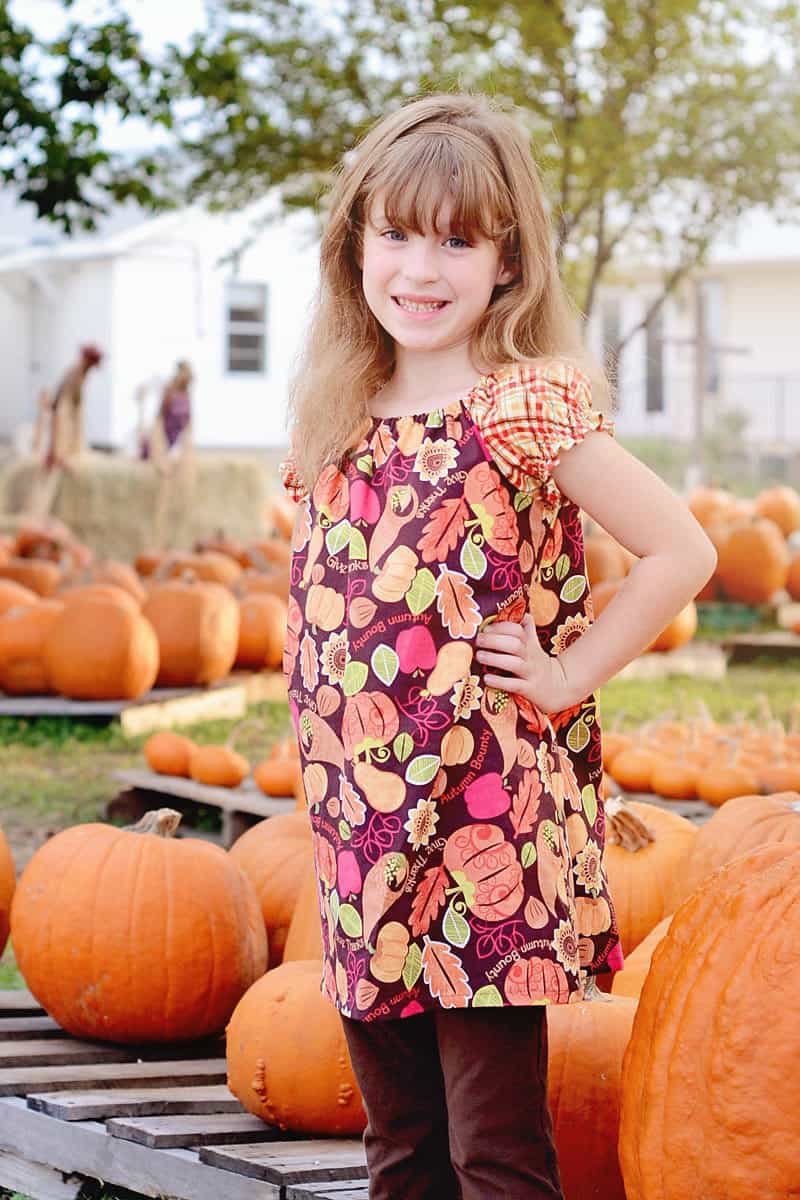
For the peasant dress version I’m showcasing today, I opted to keep the dress simple and let the two fabrics make the statement for our fall pumpkin photos.
I am loving tunic length right now. The length is perfect for school as it allows my missy to wear leggings and still adhere to the dress code.
Peasant Dress Pattern Fabric Amount Suggestions
When it comes to fabric used in my sewing projects, I am very conservative. I’ll fold and refold, move fabric pieces around to use as little fabric as possible. The fabric estimates listed below are what I used for each size.
If you make a mistake or don’t cut properly, you might not have enough fabric. So cut wisely and feel free to add 1/2 yard to my suggestions below.
- 12 mo to 3t: Will easily fit on 1 yard of 40-inch wide fabric
- 4 to 6: With creative fabric wrangling on fabric with no directional fabric nap, you can just barely fit a size 6 with short sleeves on one yard of fabric. If your fabric will only go in one direction, you will need 1 3/8 yard.
- 7 to 12: you can fit these sizes + the long sleeve on 1 3/4 yard
- 14: 2 yards of fabric
- When I say “creative fabric wrangling” that means you will fold the fabric to use the least amount possible for the 1st cut, then refold for the 2nd, 3rd and 4th cut.
Fit Chart

*Note: This peasant dress pattern goes up to size 14.
Materials Needed to Sew a Peasant Dress
- Pattern (When printing, be sure to save the pattern to your pc, open in adobe reader choose auto/landscape and print at actual size.)
- 1 to 2+ yards of fabric
- 1/4 inch Elastic (I have some elastic cutting estimates at the bottom, but if possible, you should fit the dress on the child.)
- iron
- basic sewing supplies (such as Pinking shears, fabric marker or fabric chalk, scissors, ruler )
Elastic cutting guide for the peasant dress pattern
Neck Elastic:
- 12 to 18 months: 15 to 16 inches
- 2t/3t: 17 to 20 inches
- 4/6: 19 to 20 inches
- 7: 20 to 21 inches
- 8: 21 to 22
- 10: 22 to 23
- 12: 23 to 23.5
- 14: 23.5 to 24
Arm Elastic (if you chose to add arm elastic):
- 12 to 18 months: 7 to 7.5 inches
- 2t/3t: 8 inches
- 4/6: 8.75 inches
- 7: 9 to 9.5 inches
- 8: 9 to 9.5 inches
- 10: 9.75 to 10
- 12: 10.25 to 10.5
- 14: 10.5 to 11
Sewing Products and Tools Used and Recommended for this Project
- My favorite shops for fabric are Fabric.com, girl charlie and Stylish Fabrics. (My fave for knits is Funkalicious Fabrics.)
- My Sewing Machine: SINGER 9960 Quantum Stylist 600-Stitch Machine with Extension Table, Bonus Accessories and Hard Cover
- My Serger: Brother 1034D 3 or 4 Thread Serger
- Pinking Shears
- Rotary Cutter
- I love my large ruler and large cutting mat, but you may prefer to start off with a smaller Cutting set
- Dritz Dual Purpose Marking Pen
- Fray Check
- Wonder clips (I didn’t use these in the post, but they are just awesome!
Fabric Layout Guide

Pattern tips and tricks: Important, please read!
- *** Important pattern printing tip*** When printing the patterns, do not print directly from Google docs. Save the pattern to your computer and open it in your adobe acrobat reader, choose actual size auto portrait landscape and print. (If you use any program other than the adobe reader, there is no guarantee the pages will print at the appropriate size.)
- Peasant dresses/tops are designed to be roomy, if you prefer a slimmer fit, move the bodice pattern over from the fold by about 1/2 inch. (I frequently do this.)
- The short sleeves are so cute if you shirr or add elastic to the bottom. (Unless it’s a nightgown, then I usually leave the elastic out of the sleeves…)
- This Free Peasant Dress Pattern includes a 1/4 inch seam allowance unless otherwise noted in the instructions.
- Pattern note: If you choose to sew the long sleeve version, the sleeves sew up just like short sleeves and you can finish the edges with elastic, a regular quarter-inch hem (where you fold 1/4 inch, press, fold another 1/4 inch, press and sew.) or with the quarter-inch hem and shirring. It’s cute in all ways.
- The long sleeve pattern comes in a regular (fuller) sleeve style and a narrow sleeve for knits. (I only recommend the narrower version when you are using stretch/knit fabric.)
Update: the latest version of the adobe reader allows you to print different layers. Each pattern size is on its own layer, so you are able to save ink and print only the size you need. (Click the icon that looks like a stack of papers to see the layers and click the eyeball to turn off the ones you don’t want.)

Have fun making your dresses and as always, if you sew something from one of my tutorials or patterns I would love to see it! Be sure to come back and share a photo on my facebook page or tag me on Instagram @scatteredmom, with #scatteredmompatterns!
FYI: I update my patterns yearly with new sizes! To be notified about new patterns, tutorials pattern updates and fun family recipes, be sure to sign up for my weekly newsletter. =>> Here.
Ready to Learn How to Sew a Peasant Dress?
Visit my Shop and add the free pattern to your cart and check out. Then come back here for the sewing instructions.
Where Do I get the Pattern?
- To get the pattern, don’t forget, you must navigate to the peasant dress pattern page in my shop.
- Enter your name and email and check out (it’s free.)
- The pattern will be emailed to you.
- Click the Pattern link and the pattern automatically saves to your computer.
- Open The free Adobe reader and then open the pattern file. (Don’t print from directly from google’s online version of adobe reader. It will sometimes cause the pattern to print to small or it just won’t open.)
Pattern Info:
- All measurements are in inches.
- Seam allowance is 1/4 inch with a 1/2 inch bottom.
Peasant Dress Sewing Instructions
(printable instructions, with no photos, can be found at the bottom of page)
Step 1: Print your pattern pieces and cut them out and tape them together.
Full pattern looks like this:

Assembly in progress:

Tip: There are two necklines on the dress pattern piece. To make it easier, you can print the bodice pages twice, then cut out the back neckline on one and the front neckline on the second. (or just trace it on another sheet of paper.)

Step 2: Cut pattern pieces from fabric:
Line dress and sleeve pattern pieces up on the fold of the fabric.

Cut one front dress piece, one back dress piece, and two sleeves. (Using either the short sleeve or long sleeve pattern.)
If using the long sleeve pattern, there is an optional narrow sleeve for use on a stretch knits only.

You will have: 1 Front piece, 1 back piece and 2 sleeves.
Step 3: Assemble the dress.
Right sides together, line up the sleeve edges with the armhole edges of the dress front. Sew along this seam (marked in blue) using the 1/4 inch seam allowance and finish the edge with a serger, zig zag stitch or Pinking Shears.

Grab the back dress piece and line up the other sleeve edges and sew the arm/sleeve edges the same way.

When you are done with this step the pieces will connect like below. (No laughing at my drawing skills…)

Next, line up the front and back pieces and sew down the sleeve edge all the way to the bottom of the dress, do both sides and finish the seam edge with your preferred method.
Step 4: Create the Elastic Casing.

To create the neck casing, fold the edge of the neckline in 1/4 inch and press. Fold the neckline over another half inch and press again. Use pins if needed, but be careful not to melt your pinheads when pressing!

Stitch along the edge of the casing, a scant 1/8 inch from the folded edge. Backstitch at the beginning and end and leave a 1.5 inch opening in the casing to insert the elastic.
Cut your elastic according to this guide. (Keep in mind you may want to cinch up your neck line more or less depending on how the dress is fitting:)
- 12 to 18 months: 15 to 16 inches
- 2t/3t: 17 to 20 inches
- 4/6: 19 to 20 inches
- 7: 20 to 21 inches
- 8: 21 to 22
- 10: 22 to 23
- 12: 23 to 23.5
- 14: 23.5 to 24
Attach a safety pin to the edge of the elastic and thread the elastic through the casing. Have your model try on your dress if possible and make any needed adjustments.

Sew the elastic ends together (Be careful not to twist them) using a wide zigzag stitch and trim any excess elastic. Finish sewing the elastic casing closed.
Step 5: Hemming the Dress.
Fold the bottom edge over 1/2 inch, press, fold over another 1/2 inch press again and sew along the folded edge.

Step 6: Sleeve Finishing Options:
To finish the sleeves of your dress, you have a couple of options: Shirring the Sleeve edge, creating a casing and adding elastic or just hemming.
Here are some examples of the different sleeve options and the instructions to do them:
1. Shirring the sleeve edge:

Fold the sleeve edge over 1/4 inch, press, fold another 1/4 inch press again and sew along the folded edge. With elastic thread on your bobbin, add 3 to 4 rows of shirring, 1/4 inch apart. For a more detailed shirring tutorial, see my shirred sundress tutorial.
2. Adding a casing:

The arm casings are created just like the neck casing. Elastic cutting guide lengths for the arms:
- 12 to 18 months: 7 to 7.5 inches
- 2t/3t: 8 inches
- 4/6: 8.75 inches
- 7: 9 to 9.5 inches
- 8: 9 to 9.5 inches
- 10: 9.75 to 10
- 12: 10.25 to 10.5
- 14: 10.5 to 11
3. Hemming the sleeves:

You can also hem the sleeve w/out adding elastic as I did with this nightgown. This is the easiest option and is still very cute. Just fold the sleeve edge over 1/4 inch, press, fold over another 1/4 inch press again and sew.

That’s it! Your peasant dress is done! Go have your little one try it on and pose for a few pictures to share!
Don't miss any more posts!

Stay connected by following along on Pinterest, Facebook, Instagram, and TikTok for more fun content, easy recipes, free sewing patterns, and creative inspiration.
How to Sew a Peasant Dress

Learn to sew a peasant dress with this free girl's peasant dress pattern. Peasant Dresses truly are one of the simplest dresses to sew. No buttons, zippers or labor intensive fabric gathering is needed.
Materials
- Pattern (When printing, be sure to save the pattern to your pc, open in adobe reader choose auto/landscape and print at actual size.)
- 1 to 2+ yards of fabric
- 1/4 inch Elastic (I have some elastic cutting estimates at the bottom, but if possible, you should fit the dress on the child.)
- iron
- basic sewing supplies (Ex: Pinking shears, fabric marker, pins, scissors, ruler )
Tools
- Sewing machine
- Basic Sewing supplies
Instructions
Step 1: Print your pattern pieces and cut them out and tape them together.
- Tip: There are two necklines on the dress pattern piece. To make it easier, you can print the bodice twice (page 1 and 2) then cut out the back neckline on one and the front neckline on the second.
Step 2: Cut pattern pieces from fabric:
- Line dress and sleeve pattern pieces up on the fold of the fabric.
- Cut one front dress piece, one back dress piece, and two sleeves. (Using either the short sleeve or long sleeve pattern.)
- Tip: If using the long sleeve pattern, there is an optional narrow sleeve for use on a stretch knits only.
- You will have: 1 Front piece, 1 back piece and 2 sleeves.
Step 3: Assemble the dress.
- Right sides together, line up the sleeve edges with the armhole edges of the dress front. Sew along this seam (marked in blue) using the 1/4 inch seam allowance and finish the edge with a serger, zig zag stitch or Pinking Shears.
- Grab the back dress piece and line up the other sleeve edges and sew the arm/sleeve edges the same way.
- When you are done with this step the pieces will connect like below. (No laughing at my drawing skills…)
- Next, line up the front and back pieces and sew down the sleeve edge all the way to the bottom of the dress, do both sides and finish the seam edge with your preferred method.
Step 4: Create the Elastic Casing.
- To create the neck casing, fold the edge of the neckline in 1/4 inch and press. Fold the neckline over another half inch and press again. Use pins if needed, but be careful not to melt your pinheads when pressing!
- Stitch along the edge of the casing, a scant 1/8 inch from the folded edge. Backstitch at the beginning and end and leave a 1.5 inch opening in the casing to insert the elastic.
- Cut your elastic according to this guide. (Keep in mind you may want to cinch up your neck line more or less depending on how the dress is fitting:)
- 12 to 18 months: 15 to 16 inches
- 2t/3t: 17 to 20 inches
- 4/6: 19 to 20 inches
- 7: 20 to 21 inches
- 8: 21 to 22
- 10: 22 to 23
- 12: 23 to 23.5
- 14: 23.5 to 24
- Attach a safety pin to the edge of the elastic and thread the elastic through the casing. Have your model try on your dress if possible and make any needed adjustments.
- Sew the elastic ends together (Be careful not to twist them) using a wide zigzag stitch and trim any excess elastic. Finish sewing the elastic casing closed.
Step 5: Hemming the Dress.
- Fold the bottom edge over 1/2 inch, press, fold over another 1/2 inch press again and sew along the folded edge.
Step 6: Sleeve Finishing Options:
- To finish the sleeves of your dress, you have a couple of options: Shirring the Sleeve edge, creating a casing and adding elastic or just hemming.
- Here are some examples of the different sleeve options and the instructions to do them:
1. Shirring the sleeve edge:
- Fold the sleeve edge over 1/4 inch, press, fold another 1/4 inch press again and sew along the folded edge. With elastic thread on your bobbin, add 3 to 4 rows of shirring, 1/4 inch apart. For a more detailed shirring tutorial, see my shirred sundress tutorial.
2. Adding a casing:
- The arm casings are created just like the neck casing. Elastic cutting guide lengths for the arms:
- 12 to 18 months: 7 to 7.5 inches
- 2t/3t: 8 inches
- 4/6: 8.75 inches
- 7: 9 to 9.5 inches
- 8: 9 to 9.5 inches
- 10: 9.75 to 10
- 12: 10.25 to 10.5
- 14: 10.5 to 11
3. Hemming the sleeves:
- You can also hem the sleeve w/out adding elastic as I did with this nightgown. This is the easiest option and is still very cute. Just fold the sleeve edge over 1/4 inch, press, fold over another 1/4 inch press again, and sew.
That’s it!
- Your peasant dress is done! Go have your little one try it on and pose for a few pictures to share!

Hello! I commented on July 2, 2014, and I am back for more. I used your idea to make dresses out of my late father's shirts, and I love how they turned out. I am giving you credit and linking to your blog on my post. Thank you so much! http://scrapbookofsorts.blogspot.com/2015/07/the-dresses-i-made-from-dads-shirts.html
I just saw this, Adorable!
This was very helpful (I never made a peasant dress before). I just finished my daughters dress and I will be linking your tutorial to my blog. Thanks again!
Hi, have tried this dress and turned out great. My daughter is happy with this dress and also have sewn her tank top. All of your patterns are easy to follow with detailed instructions, photos and suggested variations. Wow, you are great. Will like to thank you for such great free and easy to follow patterns. Will you mind if I share link for this pattern on other blogs or site? Thank you very much!
Hi Amruta, I'm happy to have you share the link to the tutorial posts! I made a choice to not to sell my patterns, but to share them for free and just make what I can from the advertisements on my blog. So the more people who visit, the better! (Keeps me in craft supplies and fabric, lol!)
Thanks for asking!
~Jamie
I just wanted to thank you for this awesome pattern! Your instructions and photos are so easy to follow. I was able to bust out three dresses last week with varying accents for my daughter! Will definitely be making more.
Hi Jamie,
I had just sewn a top for my 2+ year old daughter and it turned out lovely.
Was wondering what the front and back necklines measurements would be for an adult woman (size 10/12 UK) and how much elastic would be needed, please?
Thanks.
Hi, I don't have those measurements yet, but it is definitely on my to do list!
Thank you so much for the pattern and the tutorial. Made the dress tonight for my little baby granddaughter. I did a Minnie Mouse dress for our trip to Disney world. Wish I knew how to post a pic so you could see it.
I love your peasant dress pattern. Thank you for sharing! I am new to sewing and already made a long sleeve version. I am now working on a short sleeve peasant dress and would like to shirr the sleeves. I followed your link and found many helpful tips but am still a little confused. Your tutorial for the shirred dress has you shirring the front and back before sewing them together. How do I do this with my short sleeves that are already stitched together? Do I back stitch at the beginning and end of each row? Would it be easier in the future to shirr the sleeves before sewing the sleeves and body together? Thank you :)Roxanne
oops, sorry I missed this comment until just now. For the peasant dress sleeve, I shirred "in the round." Meaning, after the sleeve was attached to the dress, I stared at the bottom edge of the sleeve and kept going in circles without stopping until I got 3 rows. Hope that helps!
~Jamie
Do we print the pattern pieces for the peasant dress in Landscape?
Yes, save the pattern to your computer. Open the file, remove all printer formatting and choose Landscape for printing. Good Luck!
~jamie
I made the long sleeve version of this for my Daughter for her 3rd grade wax museum. It was perfect & very simple!
Do you have sizing up directions/suggestions? I love this pattern and use it often for my own daughters. But my daughter wants to make one for a friends who is a size 10
I am hoping to try this pattern. I've never made a dress before but I think this will be super cute for my 9 month ild
I followed your directions, but I cannot get the pattern to print the appropriate size. It's about 1/4" off no matter what I do. Please help!!
Without being there, I can't diagnose the problem, I'm sorry.
Jamie
I'm sorry Jackie, the file is too large to email. Hopefully you can get someone to help you figure out how to print the pattern.
~Jamie
how much would I have to add for a size 10/12 ? Thank you
I'm sorry, Linda. I don't have those measurements worked out yet. I'll update the post when I do!
~Jamie
♡♡♡
I just tested it and didn't have any issues on my end, but I re-uploaded it to change the link, just in case. (Plus I saw someone shared the pattern link instead of the post link on facebook- which violates my terms of use- and is just not nice…)
When printing, make sure to open the pattern in the real adobe reader and print from there. I've notice if you try to print from the reader app associated with google drive/docs, patterns don't always print to scale.
Good luck and let me know if you have any other issues.
~Jamie
I found a weird workaround. At first I was just trying to download the pattern to my desktop, which is what gave me the error. Then I hit print, which opened up an Adobe Reader dialogue box. Then I hit cancel print, which left the PDF open in Reader. From there I was able to save it to my desktop from this weird shadow menu that appeared at the bottom of the document if I sort of hovered my mouse over it. Bizarre, but I made it work. Thanks! I can't wait to get started.
hi Sarah, I have not seen this happen before. I will check it out when I get home. Are you logged into Google? we might be able to use Dropbox if there are still problems later.
Jamie
Really cute little dress,thought i would try to make this for my great niece. I thought i would try to make this for my great niece, it's been a long time since i for sewn anything . But i was wondering how much of a seam allowance did you leave? Thanks for sharing this pattern!!
The pattern includes one-fourth inch seam allowance.
good luck,
Jamie
Just wanted to let you know that I finally was able to get the pattern.
Thanks.
Thank you so much for this! I have just started sewing again after many, many years, and this was so easy and non- threatening. I'm sure my 5 year old granddaughter will love it. I am so grateful.